
The power went out at 4pm. The lines company app says “estimated restoration: assessing.” Outside, the wind hasn’t dropped since lunchtime. If you’re on tank water, the freezer is the least of your problems no power means no pump, which means no shower, no washing up, and no toilet flush by tomorrow morning.
Power Station vs Generator vs Solar
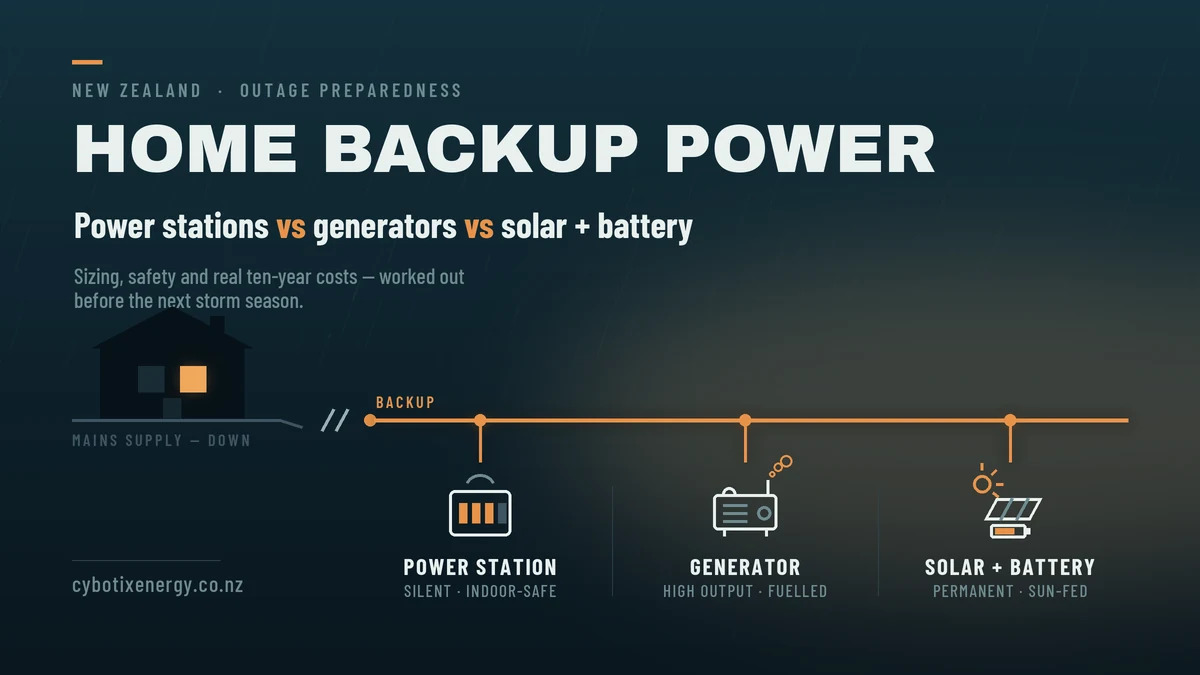
Choosing home backup power for NZ weather events comes down to three real options: a portable power station, a petrol or diesel generator, or a solar and battery system wired for outages. They solve different problems, at very different price points. Here’s how to work out which one your house actually needs.
The short answer: which option fits which NZ household
For most urban homes facing outages of a few hours to a day, a portable power station is the practical choice silent, safe indoors, no fuel. For rural properties facing multi-day outages with a water pump to run, a generator is hard to beat on cost per watt. Solar plus a battery is the permanent fix, and the biggest commitment.
Pick this if:
- Portable power station: you live in an apartment or townhouse, outages are short, or you need something you can use inside without ventilation worries.
- Generator: you’re rural or on a lifestyle block, outages run into days, and you need to run a bore or pressure pump.
- Solar + battery: you own the roof, you’re staying put, and you want the system to earn its keep every day rather than sitting in the shed.
- A combination: which is what most people with real outage experience end up running. More on that below.
Work out what you are protecting first
Don’t start with products. Start with the loads you can’t lose. That list is shorter than most people assume, and it’s what determines the size of everything else.
The essentials for a typical NZ household:
- Fridge and freezer: around 100–200W running, but with a startup surge several times that
- Water pump: the big one on tank or bore supply, often 500–1,000W running with a surge of 2,000W+
- Internet and phones: modem, router or Starlink, plus charging; small loads, high value
- Lighting: LEDs are trivial, maybe 5–10W each
- Medical equipment: a CPAP runs roughly 30–60W, more with the humidifier on
- Cooking: a kettle or microwave draws 1,500–2,400W, which is where small units struggle
Two things townies routinely forget. If your water is pumped, an outage is a water outage. And if your wastewater goes through a pumped septic system, that stops too.
Space heating is usually where people have to compromise. An electric heater at 2,000W will flatten a 2kWh battery in an hour. A wood burner, a good sleeping bag and a hot water bottle are a more realistic plan.
The three options explained
Portable power stations a battery in a box
A power station is a lithium battery, inverter, charger and outlets in one portable unit. Most current models use LiFePO₄ cells rated for 3,000+ charge cycles, which is why they’ve largely displaced older lithium-ion designs for backup use.
Two numbers matter, and people fixate on the wrong one:
- Watt-hours (Wh): how much energy is stored. This sets your runtime.
- Watts (W): How much the inverter can deliver at once. This sets what you can plug in.
A 2,000Wh unit with a 1,000W inverter will run your fridge and lights all night but won’t boil a jug. Check the surge rating too fridges and pumps draw a brief spike on startup that trips undersized inverters.
Many mid-range and larger units accept expansion batteries, so you can start modest and add capacity later. Most also charge from solar panels, which matters when the outage is the reason you need power.
Petrol and diesel generators cheap watts, real hazards
Generators give you the most output per dollar. A mid-size unit will run a water pump, a fridge and a few circuits for as long as you keep feeding it.
Two broad types:
- Inverter generators: quieter, more fuel-efficient at part load, and produce a cleaner waveform that’s safer for electronics. More expensive per kW.
- Conventional open-frame generators: cheaper and higher output, but loud and less refined electrically.
The trade-offs are genuine. They’re noisy, they need fuel stored on site, they require maintenance, and they can never run indoors or in a garage. Petrol also degrades in a few months without a stabiliser, so a can bought last summer may not start the unit this winter.
Solar + battery permanent resilience, highest commitment
Here’s the thing most NZ homeowners with solar don’t discover until the lights go out: a standard grid-tied solar system shuts down during a power cut. Inverters are required to disconnect when the grid goes down, to protect line workers. Panels on the roof, sun in the sky, no power in the house.
To have solar that works in an outage you need a hybrid inverter with backup or islanding capability, a battery, and usually a backup circuit or essential-loads sub-board wired by a registered electrician. That’s a different install and a different price.
Done properly, it’s the only option that reduces your power bill on the other 360 days of the year which is what makes the maths work over a decade.
Comparison table
| Power Station | Generator | Solar + Battery | |
|---|---|---|---|
| Upfront cost (NZD, indicative) | $1,000–$6,000 | $800–$3,000 + install | $15,000–$35,000+ |
| Running cost | Electricity to recharge | Ongoing fuel | Near zero |
| Typical runtime | Hours to a day per charge | As long as fuel lasts | Days, with sun |
| Safe indoors? | Yes | Never | Yes |
| Noise | Silent | Loud | Silent |
| Recharge during outage | Solar panels or generator | Refuel | Sun |
| Maintenance | Minimal | Regular servicing | Minimal |
| Apartment-friendly | Yes | No | No |
| Heavy loads (pumps, jugs) | Model dependent | Yes | Yes |
| Daily bill savings | No | No | Yes |
| Best fit | Urban, short–medium outages | Rural, multi-day | Owner-occupied, long term |
Sizing it properly: watts, watt-hours and surge
Add up the continuous draw of everything you’ll run at once that’s the inverter size you need. Multiply your average draw by the hours you want to cover that’s the capacity. Then check the surge rating against your largest motor load.
Realistic figures to work with:
| Appliance | Running watts | Startup surge |
|---|---|---|
| Fridge-freezer | 100–200W | 600–1,200W |
| Water pressure pump | 500–1,000W | 2,000–3,000W |
| Wi-Fi router / Starlink | 10–70W | — |
| LED lights (×6) | 40–60W | — |
| Laptop | 45–90W | — |
| CPAP machine | 30–60W | — |
| Microwave | 1,000–1,500W | — |
| Electric jug | 1,800–2,400W | — |
A worked example. Fridge (150W average), router (30W), lights (50W), phone charging (20W) is about 250W continuous. A 2,000Wh power station at roughly 90% inverter efficiency gives you around 7 hours at that draw comfortably overnight if the fridge cycles rather than runs flat out, which it will.
Add a water pump and the picture changes completely. It’s the surge, not the average, that decides whether the unit copes.
The NZ factors that change the answer
How long do outages actually last here?
An urban fault is often restored in a couple of hours. A major storm or cyclone in a rural area is a different category of event, where restoration is measured in days because crews have to clear vegetation and rebuild lines before anyone gets power back.
That gap is the whole decision. A battery sized for four hours is fine for one and useless for the other.
Rural water, septic and satellite internet
Rural households have loads that urban ones don’t: the pressure pump, sometimes a bore pump, a pumped septic system, and Starlink or a rural wireless connection that needs continuous power to keep working.
A bore pump in particular can be well beyond what a portable unit will start. Check the nameplate rating before you buy anything.
Recharging when the outage is the problem
This is where plans fall apart. Power stations recharge from solar panels but a 400W folding panel array in a New Zealand winter might return roughly 1–1.5kWh across a short, overcast day. That’s a partial top-up on a 2kWh unit, not a refill.
Generators depend on stored fuel. Service station pumps are electric too, so a widespread outage can mean no fuel available locally. Store what you’ll need before the season starts, and rotate it.
Winter southerly vs summer cyclone
Solar recharging is far more useful after a February storm than during a July cold snap. Short days, low sun angle and heavy cloud mean winter yield can be a fraction of summer. If your outage risk is mainly winter, don’t build a plan that depends on daytime solar input.
Safety: the part that actually matters
Generators run outdoors, always. Never in a garage, never in a carport, never in a shed with the door open. Carbon monoxide is colourless, odourless, and has killed people in New Zealand doing exactly this. Keep the exhaust well away from open windows and doors.
Never plug a generator into a wall socket. Double-ended “suicide” leads backfeed power into the network and can kill line workers repairing your street. Connecting a generator to house wiring requires a proper changeover switch installed by a registered electrician. That’s the law here, and it’s the reason the law exists.
Fuel: store petrol in approved containers, outside living areas, in modest quantities. Add a stabiliser if it’s sitting more than a few months.
Batteries: keep power stations out of direct sun and away from heat sources, and don’t cover the vents while charging.
If someone in the house depends on mains-powered medical equipment, register as a medically dependent consumer with your electricity retailer. It doesn’t guarantee power, but it does put you on the list that matters and you should still have your own backup.
Cost over ten years, not day one
A generator is cheapest to buy and most expensive to run. A power station has almost no running cost but a capacity ceiling. Solar plus a battery costs the most upfront and is the only one that pays anything back.
Roughly how it stacks up over a decade:
- Generator: hardware plus transfer switch install, then fuel for every outage, servicing, and a fuel stock you rotate whether you use it or not.
- Power station: hardware, negligible recharging cost, likely still serviceable at year ten given LiFePO₄ cycle life.
- Solar + battery: the largest cheque, offset by daily bill reduction across ten years, with the battery as the wearing component.
Pros and cons at a glance
Power station
- ✅ Silent, safe indoors, zero fuel, minimal maintenance, apartment-friendly
- ❌ Limited capacity, may not start large pumps, slow to recharge without mains
Generator
- ✅ Most watts per dollar, runs indefinitely with fuel, handles heavy loads
- ❌ Carbon monoxide risk, loud, needs fuel and servicing, unusable in apartments
Solar + battery
- ✅ Works every day, no fuel, silent, largest usable capacity
- ❌ High upfront cost, needs suitable roof and ownership, requires a hybrid inverter setup
Common NZ setups and what we’d recommend
Apartment or urban townhouse
A power station in the 1–2kWh range. Generators aren’t an option no safe outdoor space, and the noise won’t survive your neighbours.
Suburban family home, occasional storm outages
A 2–3kWh power station sized around fridge, internet and lighting, plus a folding solar panel. Covers the overwhelming majority of what you’ll face.
Rural or lifestyle block, tank water, multi-day outages
Be honest about the pump. Either a generator with a properly installed changeover switch, or a solar and battery system specced for genuine off-grid operation. A power station alone won’t carry a rural property through day three.
Medical equipment in the house
Build for reliability, not price. A power station with expansion capacity, tested monthly, kept charged, with a documented plan and register with your retailer.
Can you combine them?
Yes, and it’s what experienced people actually do. Solar and battery as the base layer. A power station for silent overnight loads and to move power where you need it. A generator held in reserve for day three, or to bulk-charge the power station when the sky stays grey.
Most power stations will charge from a generator’s AC output, which lets you run the noisy thing for two hours in the afternoon and stay silent all night. It’s a good pattern.
Mistakes that leave people in the dark
- Buying on watt-hours alone and discovering the inverter won’t start the fridge.
- No fuel stored: or year-old petrol with no stabiliser.
- Never load-testing. Plug in your actual fridge before the storm, not during it.
- Solar panels bought too small to meaningfully recharge anything.
- Storing a battery at low charge for months, then needing it.
- No transfer switch on a generator, and improvising something dangerous instead.
- Forgetting the low-tech kit torches, a battery radio, a card of cash, printed contact numbers.
Five questions before you buy
- How long is a realistic worst-case outage where you live?
- Is your water pumped?
- What’s the largest motor load you must start?
- Do you have a safe outdoor space for a generator?
- Do you own the property long-term?
Answer those and the choice narrows fast. If you’d rather have someone size it against your actual appliance list and outage risk, talk to our team including when the cheapest option is the right one.
FAQs
Will my solar panels work during a power cut?
Not on a standard grid-tied system. Inverters are required to shut down during an outage to protect line workers. You need a hybrid inverter with backup capability and a battery for solar to keep running.
How long will a power station run a fridge?
A 2,000Wh unit will typically run a modern fridge-freezer overnight and often through a full day, because the compressor cycles rather than running constantly. Add other loads and that drops proportionally.
Can I run a generator in my garage with the door open?
No. Carbon monoxide accumulates in enclosed and partly enclosed spaces and has caused deaths in New Zealand. Generators run outside, well clear of doors and windows, with no exceptions.
What size generator do I need for a NZ house?
For essentials including a water pump, most households look at 3–5kW. Whole-house operation needs considerably more. Size it on your largest surge load, not your average draw.
Is a power station worth it for short outages?
For two- to four-hour outages, yes it keeps the fridge, internet and lights running with no setup and no noise. If your outages run into days, treat it as one layer rather than the whole plan.
Do I need an electrician?
For a portable power station used with extension leads, no. For anything connected to your house wiring generator changeover switches, hybrid inverters, backup circuits yes, a registered electrician is required.
Should I choose LiFePO₄ over other lithium batteries?
For backup use, generally yes. LiFePO₄ cells offer longer cycle life and better thermal stability, which matters for something that sits charged for months and then works hard.