You already own a tablet. It displays books perfectly well, it cost a lot, and now someone’s suggesting you buy a second device that does considerably less.
The honest answer to whether eReaders are better than tablets for reading: yes for reading, no for everything else. Which sounds like a dodge until you realise the whole decision turns on one variable most comparisons never mention how long you read in a single sitting.
Here’s the test, then the detail.
Are eReaders better than tablets for reading?
For sustained reading, yes. No glare, no screen flicker, battery measured in days, and nothing on the device competing for your attention.
For everything else video, browsing, colour, speed, magazines, one device instead of two a tablet wins comfortably. It’s the more capable machine and that isn’t close.
So the question isn’t which is better. It’s whether the reading advantage is worth carrying a second device for.
The test that actually decides it
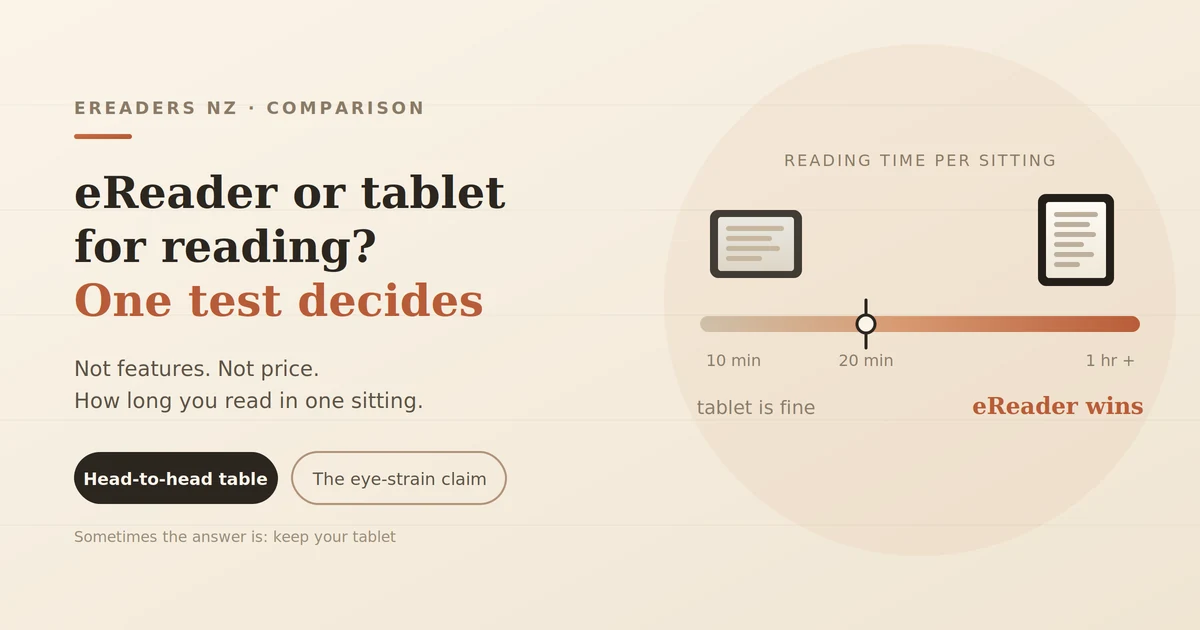
Skip the feature lists. Ask yourself how long you read in one sitting.
Under 20 minutes at a time a tablet is genuinely fine. Fatigue barely registers in a short session, battery isn’t an issue, and a second device would sit in a drawer. Don’t buy one.
20 to 45 minutes borderline. You’ll notice the difference, but whether it justifies the spend depends on how often.
An hour or more, most days this is where it compounds. The comfort difference over a long session is real, and so is not having your book interrupted by everything else the tablet does.
That’s the decision. Everything below explains why.
Where eReaders genuinely win
Four real advantages, and they’re physical rather than marketing.
No glare, and it improves in sunlight
E Ink reflects ambient light rather than emitting it the same way paper does. So a matte surface, no glare, and contrast that improves as conditions get brighter.
Take a tablet outside on a bright Hawke’s Bay afternoon and you’re fighting the sun with brightness. Take an e-reader out and it gets easier to read. That inversion catches people out the first time they experience it.
The mechanism is covered properly in our explainer on how E Ink technology works.
Battery measured in days
E Ink only draws power when the page changes. Hold a page and it costs nothing which is why a charged e-reader survives a week of commuting while a tablet wants charging nightly.
Realistic figures and what actually drains it are in our guide to how long an e-reader battery lasts.
Nothing else on the device
This is underrated, and for a lot of people it’s the real reason they switch.
A tablet is a general-purpose computer that happens to display books. Every time you pick it up, the book is competing with everything else on it. You intend to read a chapter; you check something, then something else, then you’ve lost twenty minutes.
An e-reader is a slab of text. There’s nothing to get distracted by because there’s nothing else on it.
Weight over a long session
Most e-readers sit around 150–250g. Tablets are typically two to three times that. Holding one in bed for an hour is noticeably different from holding the other.
Where tablets win, and it’s not close
Being straight about this makes the rest credible.
- Colour. Real, vivid colour. E Ink is greyscale, or muted where colour exists at all.
- Speed. Page turns, scrolling, tapping all instant. E Ink has visible lag.
- Complex PDFs, magazines and comics. Layout-heavy content needs colour and quick zoom.
- Video and everything else. An e-reader does none of it.
- One device. A tablet reads, watches, browses and works. That’s genuinely valuable.
- Cost, if you already own one. The tablet is a sunk cost. The e-reader isn’t.
If you read a mix of novels, magazines and comics, the tablet may simply be the better tool.
Head to head
| eReader | Tablet | Phone | |
|---|---|---|---|
| Screen | Reflective E Ink | Backlit LCD/OLED | Backlit LCD/OLED |
| Direct sunlight | Improves | Washes out | Washes out |
| Battery | Days to weeks | 8–12 hrs | Hours |
| Page refresh | Slight lag | Instant | Instant |
| Colour | Greyscale or muted | Full | Full |
| Flicker | None | Possible (PWM) | Possible (PWM) |
| Distraction | Almost none | High | Highest |
| Weight | 150–250g | 450–700g | 170–240g |
| Best for | Long-form reading | Everything | Short bursts |
The phone column matters because that’s what most people actually read on, not a tablet.
The eye-strain question, answered properly
This gets overstated constantly, including by retailers who should know better. Here’s the accurate version.
What’s genuinely supported. E Ink is reflective, not emissive you’re reading room light bouncing off the page, so nothing shines into your eyes. The surface is matte, so no glare. And there’s no PWM flicker from the display, which some people are sensitive to on LCD and OLED screens. Guidance from eye health bodies consistently points at glare reduction and increased contrast as ways to reduce digital eye discomfort, and E Ink delivers both.
What’s overstated. “No blue light” isn’t accurate on a device with the frontlight switched on those are LEDs, and they emit light including blue wavelengths. That’s exactly why warm-light settings exist. With the light off, the claim holds.
What isn’t established. That e-readers prevent eye strain or protect your eyesight as a medical outcome. Plenty of readers report less fatigue over long sessions, and the absence of glare and flicker is a reasonable explanation for that. It’s a comfort benefit, not a health intervention.
Buy one because reading on it is more comfortable. That’s a good enough reason and it’s true.
Reading before bed
A common reason people look into this, so it deserves a straight answer.
The evidence on screens and sleep is less settled than popular coverage suggests, and the effect sizes reported in studies are generally modest. What’s clearer is that bright light close to your eyes late at night is worth reducing, which is why warm-light settings exist on e-readers, tablets and phones alike.
An e-reader helps in two ways. You can turn the frontlight down or off entirely and still read with a lamp, which a tablet can’t do. And there’s nothing else on it so you read until you’re sleepy rather than reading, then checking something, then being awake.
Honestly? The second effect probably matters more than the screen technology. If you find yourself still on your phone at midnight having opened it to read, that’s the problem a dedicated device solves.
What about reading on your phone?
Most people comparing e-readers aren’t comparing against a tablet at all they are comparing against the phone in their pocket.
Phones are worse for reading than tablets on every count except portability. Smaller screen, more notifications, and the strongest habit loop of any device you own. Picking up your phone to read is the moment most reading sessions quietly become something else.
If you currently read on your phone and wish you read more, an e-reader will probably change that more than any app will.
The cost question
Be honest about this: you already own a screen that displays books, so this is a second device and a genuine expense.
The framing that works isn’t cost against the tablet’s price. It’s cost against how much you actually read. Someone reading an hour a night is using it for 350 hours a year, and a few hundred dollars across that is reasonable. Someone reading twenty minutes a fortnight is buying a very expensive drawer ornament.
There’s no shame in the second answer. Most people who buy an e-reader and stop using it read less than they thought they did when they bought it.
Who should buy an eReader
- Heavy novel readers an hour or more most days, mostly text
- Commuters light, one-handed, lasts a week on a charge
- Bedtime readers who want fewer reasons to stay up
- Outdoor readers beach, deck, park, anywhere with real sun
- Students with PDF-heavy courses though screen size matters enormously here, and our student buying guide covers why
- Anyone who writes as well as reads larger models take a stylus, covered in our guide to writing on an E Ink tablet
Who should stick with a tablet
- Light readers short bursts, a few times a week
- Magazine, comic and manga readers colour and layout matter too much
- Anyone who wants one device rather than two
- People who mostly read reference material and jump around rather than reading linearly
- Anyone on a tight budget who already owns something that works
If you’re in this list, keep your tablet. A retailer telling you otherwise is selling.
FAQs
Is an eReader better for your eyes than a tablet?
It removes glare and screen flicker, which many readers find more comfortable over long sessions. That’s a comfort benefit rather than a proven medical one and the frontlight still emits light when it’s on.
Can you read books on a tablet just as well?
For short sessions, yes. The differences show up over an hour or more, and in sunlight, and in battery life.
Do eReaders work in sunlight?
Better than in dim light. They reflect ambient light, so bright conditions improve contrast the opposite of a tablet.
Is it worth buying an eReader if I already have an iPad?
It depends on how long you read at a stretch. Under 20 minutes a sitting, probably not. An hour or more most days, most people find it worth it.
Can eReaders show colour?
Some can, but muted colour comes from a filter over black-and-white ink, so expect newspaper-quality colour rather than tablet colour.
Which is better for reading before bed?
An e-reader, mainly because you can turn the light off entirely and there’s nothing else on it to keep you up. The screen technology matters less than the absence of distraction.
Do I still need my tablet?
Yes. An e-reader replaces reading, not the tablet. Anyone suggesting otherwise hasn’t used one.
Tell us how you actually read
The useful question isn’t which device is better. It’s how long you read in one sitting, what you read, and where.
Tell us those three things and we’ll give you a straight answer including when the answer is that your tablet is fine and you should keep your money. If it does stack up, you can see the range of E Ink readers available in New Zealand.