You’ve read that screens before bed wreck your sleep. You also read in bed every night, on an e-reader, and now you’re wondering whether the thing you do to wind down is quietly working against you.
Here’s the honest answer to whether reading on an eReader is bad for sleep: with the frontlight off, an E Ink reader is reflective like paper, and there’s little reason to think it affects sleep more than a printed book. With the frontlight on, it becomes a light source but a much dimmer one than a tablet, and the evidence on that specific case is thinner than the headlines suggest.
The headlines, it turns out, aren’t about e-readers at all.
Is reading on an eReader bad for sleep?
Three positions, each honestly held:
- Frontlight off: you’re reading reflected room light. Functionally the same as a book.
- Frontlight low and warm: a small amount of light close to your face. Probably a minor effect; limited direct research.
- Frontlight at maximum in a dark room for hours: the closest thing to the conditions that produced the alarming study results, and worth avoiding.
The device matters less than how much light you’re putting into your eyes, for how long, and how close to sleep.
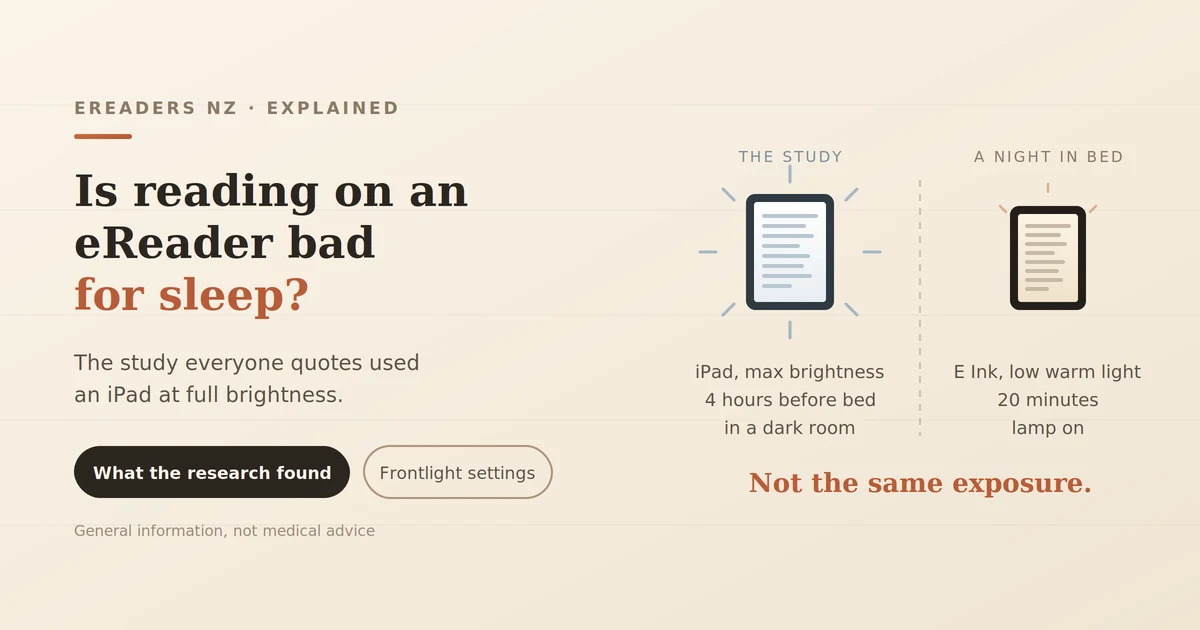
The study everyone quotes used an iPad
This is the thing worth knowing, because nearly every article on this topic traces back to one piece of research and misdescribes it.
The study is Chang et al., published in PNAS in December 2014. Its actual design:
| Study condition | Detail |
|---|---|
| Device | An iPad — the paper calls it a “light-emitting eBook,” not an E Ink reader |
| Brightness | Maximum |
| Duration | Four hours per evening, 6pm to 10pm |
| Room lighting | Very dim, so the device was the dominant light source |
| Participants | 12 adults, inpatient, over 14 days |
| Comparison | Printed book read by reflected light |
Four hours on an iPad at full brightness in a dark room is not reading a Kindle for twenty minutes before you fall asleep. Those are different exposures by a wide margin.
And then the detail nobody reports: the study’s lead author recommended E Ink readers as the alternative. Anne-Marie Chang said that anyone wanting to read before bedtime should use a printed book, or an e-book reader such as a Kindle that doesn’t emit light.
So the headline “e-readers ruin your sleep” comes from a study about tablets, whose own author pointed at E Ink devices as the solution.
What the study actually found
Worth reporting properly rather than dismissing, because the findings were real:
- Melatonin suppressed by about 55% in the iPad condition
- Dim light melatonin onset delayed by roughly 1.5 hours
- Sleep onset took about 10 minutes longer
- Less REM sleep
- Reduced alertness the next morning, even after eight hours in bed
Participants also felt less sleepy before bed on iPad nights and sleepier the following morning. That’s the pattern that makes the result interesting: the device was doing something to their body clock, not just keeping them entertained.
The fair criticisms: twelve participants is a small sample. The exposure was extreme by design, because that’s how you detect an effect in a short study. And at least one clinical commentary concluded that while the circadian phase delay was clearly demonstrated, the practical effects are probably exaggerated relative to how the study was reported.
Both things can be true. Light at night shifts your clock, and four hours of iPad at full brightness is not what most people do.
Why E Ink is different
An LCD or OLED screen emits light at your eyes. E Ink reflects ambient light off pigment, the way paper does our explainer on how E Ink technology works covers the mechanism.
That difference is the whole reason the comparison isn’t like-for-like.
The frontlight is still light
Here’s where most retailers overstate things, so let’s be accurate.
An e-reader with the frontlight on is emitting light. The LEDs sit around the edge of the screen and shine across its surface, so the light reaches you after bouncing off the page rather than shining directly at you. That’s gentler than a backlight, and the total output is far lower than a tablet at full brightness.
But “gentler and dimmer” isn’t “none.” Anyone telling you an e-reader emits no light at night is describing the panel and ignoring the lamp.
With the frontlight off, the claim holds completely you are reading reflected light, and the device is contributing nothing.
Warm light settings
Most current e-readers include amber LEDs alongside white ones, letting you shift the light warmer at night.
The reasoning is sound: shifting the spectrum away from short wavelengths reduces the signal that suppresses melatonin. Whether that translates into measurably better sleep in a real bedroom is less well established than product marketing implies.
Treat it as a sensible precaution with a plausible mechanism, not a proven fix. It also simply looks more comfortable at night, which is reason enough to use it.
Dose matters more than device
The useful mental model isn’t “screens bad, paper good.” It’s how much light, for how long, how close to sleep.
Four variables scale the effect:
- Brightness. The difference between setting 2 and setting 20 is large.
- Duration. Twenty minutes is not four hours.
- Proximity. A device 30cm from your face delivers more light to your eyes than a lamp across the room.
- Timing. Light in the hour before sleep matters more than light at 7pm.
An e-reader at low warm light for half an hour sits at the mild end of all four. A tablet at full brightness for three hours sits at the severe end. Most of the anxiety about this topic comes from applying the second scenario’s findings to the first.
What you’re actually reading on
| Light emitted | Typical brightness | Distraction risk | Likely sleep impact | |
|---|---|---|---|---|
| Printed book + lamp | None from the page | Depends on your lamp | None | Baseline |
| E Ink, frontlight off | None | — | None | Comparable to print |
| E Ink, frontlight low/warm | Low | Dim | None | Likely minor; limited direct evidence |
| E Ink, frontlight maximum | Moderate | Bright in a dark room | None | Worth avoiding at night |
| Tablet | High | Bright | High | Demonstrated circadian delay at high exposure |
| Phone | High | Bright | Highest | Same, plus the worst distraction profile |
The “limited direct evidence” note is deliberate. There’s substantial research on tablets and phones, and much less on E Ink readers with frontlights specifically. Anyone presenting a confident number for that middle row is making it up.
The factor that probably matters more than light
Here’s what I’d argue is underweighted in all of this.
A tablet keeps you up partly through light and partly because it’s a tablet. You read a chapter, check something, open an app, and surface forty minutes later still awake. The light is measurable, so it gets studied. The behaviour is harder to measure and may do more damage.
An e-reader has nothing else on it. You read until you’re sleepy, and then you stop because there’s no alternative to switch to.
If you currently read on your phone and find yourself awake at midnight having opened it to read one chapter, the problem you’re solving may not be photons at all.
Reading in bed in New Zealand
Two seasonal quirks worth knowing.
Summer. Sunset in late December runs close to 9pm across much of the country. You’re already receiving bright natural light late in the evening, which does far more to your body clock than a dim frontlight. In midsummer you likely don’t need the frontlight at all until quite late.
Winter. Dark by 5pm, and the frontlight becomes necessary. This is when people set it bright and comfortable — and then never change it back, carrying a winter setting into summer out of habit.
Worth checking your setting twice a year, when the clocks change. It takes ten seconds.
Practical settings if you read before bed
- Try it with the frontlight off and a bedside lamp instead. This is the closest setup to a printed book, and many people find it perfectly comfortable.
- If you use the frontlight, use the lowest comfortable setting. Most people run it brighter than they need.
- Switch to warm at night. Plausible mechanism, no downside, and it looks better.
- Avoid maximum brightness in a dark room that’s the condition closest to the study.
- Stop before you’re overtired. Reading until your eyes give out isn’t a sleep strategy.
- Keep the phone out of it. If you check your phone after turning off the e-reader, the e-reader isn’t your problem.
What this article isn’t
General information, not medical advice. The evidence on E Ink readers with frontlights specifically is limited, and anyone including a retailer who tells you confidently that a particular device will improve your sleep is going beyond what’s been shown.
If you have persistent trouble sleeping, that’s worth discussing with a doctor rather than solving by changing which device you read on. Sleep problems have many causes, and the one on your bedside table is rarely the main one.
FAQs
Does a Kindle affect sleep like a phone?
Much less. Phones and tablets emit considerably more light and bring a distraction problem with them. An E Ink reader with the frontlight off is closest to a printed book.
Is the frontlight bad before bed?
It’s light, so at high brightness close to sleep it’s worth reducing. At a low warm setting the exposure is small, though direct research on that specific case is limited.
Should I use warm light at night?
It’s a sensible precaution with a plausible mechanism, and it’s more comfortable to look at. Treat it as helpful rather than proven.
Is reading on an eReader as good as a paper book before sleep?
With the frontlight off, functionally very close. With it on, you’re adding a small amount of light that a book doesn’t.
Do blue light glasses help?
The evidence is weak, and major eye health bodies don’t recommend them for this purpose. Turning the light down costs nothing and does more.
How long before bed should I stop reading?
There’s no established number for e-readers. The general principle is to reduce bright light in the hour before sleep which argues for dimming rather than stopping.
Is the research on this settled?
No. Tablets and phones have been studied at high exposure levels. E Ink with a frontlight has not been studied nearly as thoroughly, which is why this article avoids confident numbers.
If you are reading in bed anyway
The single most useful change isn’t buying a different device it’s turning the frontlight down. Try it at the lowest comfortable setting, or off with a lamp, for a week and see whether you notice anything.
If you currently read on a phone or tablet and want something that does one job and then lets you sleep, that’s what these devices are for. You can look through the range of E Ink readers available in New Zealand though the honest answer is that a printed book and a dim lamp works too.